A Lesson in Optimism from My Daughter, and an Improbable Bitcoin Mining Operation
I built a Bitcoin miner this week and by any measure it’s a spectacularly terrible at its job. It runs at about 15 million hashes per second which sounds impressive but isn’t. My little machine is hopelessly outmatched compared to the big rigs.
I named it GLM-01, the Gopher Lottery Miner. It even has a fictional parent company, Gopher Capital Management, complete with an executive board consisting of the Muppets. The little guy has a face on his touchscreen, a mining helmet, and the exhausted expression of someone who has been working underground for forty years.
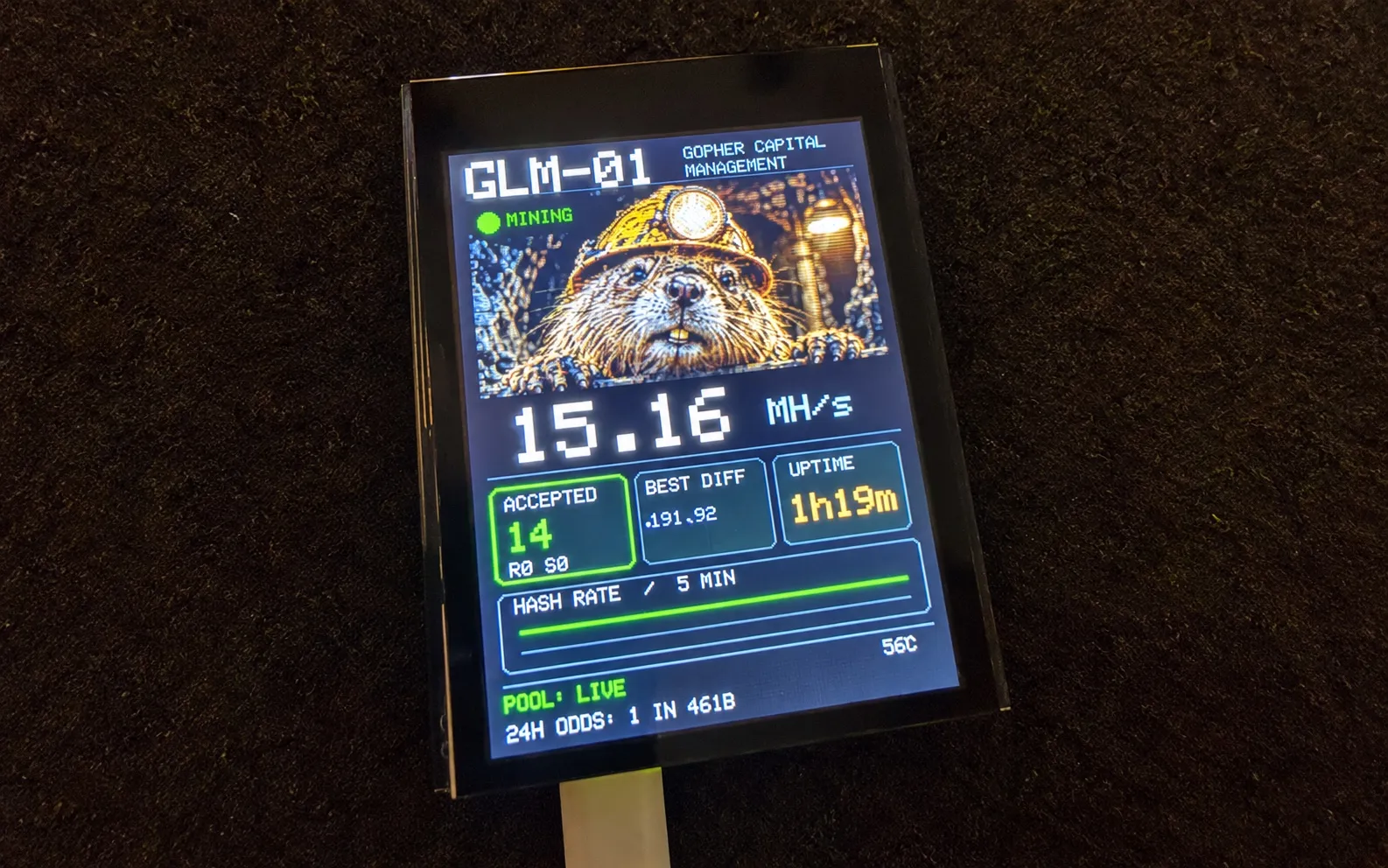
He has one simple job: try to find a Bitcoin block. Fifteen million times a second.
Maybe this time?
Nope.
Maybe this time?
Nope.
The world’s worst lottery ticket
At its current speed and the network difficulty when I built it, the average time to find a block is somewhere around 1.3 billion years. That’s about a tenth of the age of the universe. I built it because I had spare parts laying around, and the idea of entering the global Bitcoin lottery with an Arduino struck me as wonderfully absurd.
It connects to a real Bitcoin mining pool, performs real calculations, and submits legitimate results. It has even earned the occasional congratulatory acknowledgment from the mining pool for doing the mathematical equivalent of the bare minimum.
I’m ridiculously proud of it.
Then I explained it to my daughter
I showed my daughter the little miner and explained what it was doing, a cute gopher working tirelessly against the odds. I told her about Bitcoin, the reward, and the absurdly small probability that our Arduino would ever find a block. She understood, but she saw something different.
Maybe this time?
Nope.
Maybe this time?
Nope
And then she asked: “But what if it does?” I laughed. She understood the odds perfectly well, and asked the question anyway. Four words that cut straight through all the statistical improbability. All I did was put my little machine in front of her and explain what it was trying to do, and her curiosity did the rest. I think there’s something important in that.
As an adult I’ve become very good at figuring out why things won’t work and I try to make sensible decisions. But somewhere along the way, that sort of became an unconscious habit of ignoring delightfully silly pursuits and letting pessimism masquerade as being a realist.
But maybe sometimes the experience itself is the return?
Sometimes the thing you build is worth building because it’s interesting, because it makes you laugh, because it teaches you something, or because you get to share it with someone you love.
Maybe some things are worth doing even when there’s almost no chance of succeeding.
The little miner that won’t quit
There’s another part of this project I’ve grown strangely fond of. The miner runs continuously. Day and night, it calculates hashes, checks the results, and tries again.
If the power goes out, it stops. When the power comes back, the machine boots up, reconnects to the mining pool, and gets right back to work. No intervention. No encouragement. No concern about the billions of years of statistical waiting time ahead of it. Just another attempt from a tiny machine, built from spare parts, faithfully pursuing an almost impossible outcome. Not because the odds are favorable but because the possibility exists (and perhaps because its builder finds the whole thing hilarious).
I don’t expect my little gopher to find a Bitcoin block and the mathematics are pretty clear about it. But it’s already given me a lot of entertainment, a deeper understanding of Bitcoin, an excuse to build something ridiculous, and a conversation with my daughter that I won’t soon forget.
That’s a pretty good return on an Arduino that was otherwise collecting dust. And every time I walk past it, I think about her question.
Maybe this time?
Nope.
Maybe this time?
Nope.
But what if it does?