"Software is dead" — and what that actually means for your small business
In February, Mark Cuban pronounced software dead. Elon Musk went further. Here's what the headlines miss — and what a small business owner should actually do about it.
In February, Mark Cuban said three words that rattled the software industry: software is dead. The clip went viral, software ETFs slid double digits, and Cuban caught most of the press — even though he was really quoting someone else. The line came from Microsoft’s own CEO. Cuban just said it louder.
And as a business owner, your honest first reaction is probably the right one: what do you mean software is dead? What does that have to do with running my business?
Then Elon Musk went further. At a company all-hands, he predicted that by the end of this year you won’t bother writing code at all — AI will skip the languages and the compilers and write the machine code directly, ones and zeros straight to the chip. It’s a mind-bending claim. It’s also the shakiest part of this whole story — plenty of serious engineers think the timeline is fantasy, and they may be right. But hold that thought, because the timeline isn’t the point. The direction is. And the direction lands squarely on your desk.
So what did Cuban actually say?
“Software is dead because everything’s going to be customized to your unique utilization.”
Strip out the drama and it’s a simple idea. For decades, business software worked one way: you bought a tool built for the average company, and then you bent your business to fit its limits. You learned its menus. You changed your process to match its workflow. You paid every month for the privilege of adapting to it.
Cuban’s bet is that the arrow is about to flip. Instead of you adapting to the software, the software gets built around you — around your products, your customers, the way you actually work.
That matters for two reasons. First, it means you can probably stop renting a stack of tools that each do one small thing — the bookkeeping app, the website builder, the comms tool, the marketing tool. (I have.) Second, what replaces them isn’t another generic app. It’s a workstream shaped to how your business runs, executing the jobs that software used to own — faster, and without the monthly toll.
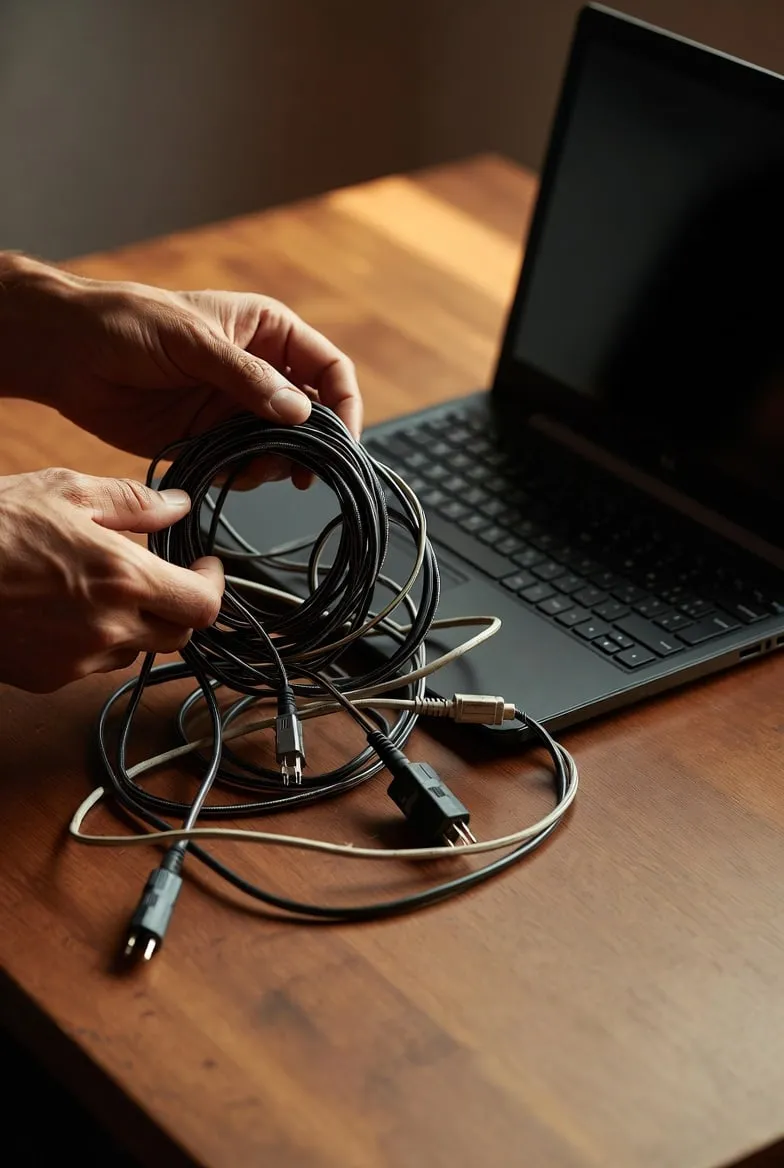
The rented stack, coiled up and set aside — replaced by one system shaped to the business.
Here’s the part most of the coverage skipped. Cuban’s point wasn’t really about the tech giants at all. It was about the roughly 33 million U.S. businesses too small to have an AI budget or an AI expert on staff. The opening, he argued, isn’t in building the next model. It’s in translating that capability into a real advantage for businesses like yours. The companies that win the next few years won’t be the ones who built the AI. They’ll be the ones who knew how to point it at a real problem.
Want proof it’s already happening?
I’m one person, in one shop, building enterprise-grade software for my own small business — not because I have a dev team, but because I no longer need one.
And the hardware is catching up to meet that reality. A couple of weeks ago, Nvidia and Microsoft unveiled the RTX Spark — a new class of computer Jensen Huang described as moving “from tool to teammate.” The pitch is blunt: instead of launching apps and clicking through menus, you ask, and the machine does the work. That’s the bridge to running capable AI agents locally, on your own desk, under your own roof. The infrastructure for the shift Cuban described isn’t a someday promise. It’s shipping.

From tool to teammate: capable AI running locally, on your own desk, under your own roof.
Now — where’s the line between real and hype?
This is where I’ll be straight with you, because you don’t need another vendor selling magic. Software is not going to vanish next Tuesday. You can’t cancel every subscription this afternoon and expect a custom system to appear in its place. What’s dying isn’t software — it’s a specific, expensive habit: the rigid, one-size-fits-all SaaS model where you pay monthly to mold yourself to someone else’s idea of your workflow.
Some of that you can replace today. Some you can’t yet. Knowing which is which — for your business, not in the abstract — is the entire game. That’s the difference between moving early and moving recklessly.
So what do you actually do about it?
You stop waiting for permission. You stop assuming the “old way” is the only way just because it’s the way you’ve always done it. And you start asking a sharper question about the tools you pay for every month: is this built around my business, or am I still bending my business around it?
You don’t need to learn to code. You don’t need to predict which model wins. You need to start positioning now — before the competitor down the road figures it out first.
Software engineering may well be dying. Workstream engineering is just entering its golden age.
I’ve got your back. I’m already living this reality inside my own business, and more detail on exactly how is coming shortly. And if you’d rather not draw the line between real and hype on your own — that’s precisely the work I do.